All types of Plaster-of-Paris including Crystacast, Crystacal R, Herculite No.2, Herculite LX, Dental SP, Crystacal Alpha K, Ultracal 30, Hydrostone, Hydrocal,
BPB Formula, Fine casting plaster 10kg.. BPB Fine casting plaster 5kg... BPBformula fine casting plaster 25kg; plaster Paris, casting powder, stone powder, keywords...
Casting Plaster ideal for general casting, case moulds and carving. Fine Casting Plaster is suitable for fibrous plasterwork including cornices, . Working with plaster for modelling purposes, fine casting plaster is probably best... 1kg packs at our craft shops to 25kg bags ... accessories, modroc, release oil silicone imprssion, latex... Flexible bucket, spatula ... alginate, bandage, jute.. chicken wire 13mm mesh
art and craft materials online shop Casting Plaster Fine casting plaster 10kg bag. Mixing Skip A flexible mixing skip. 25 litre art and craft materials from online shop Casting Plaster Mixed with water to a creamy consistency it is an ideal plaster ...
shows you how to cast various shapes in fine casting plaster by making clay moulds. ...Sculptors Tools, Modelling Materials, Prestia Casting Plaster. A fast setting general purpose plaster, used for making moulds or casting of articles where hardness of setting is not important. . Cast yourself body casts Instructions on how to make a plaster cast; Manchester & Leeds,
building materials - plasters - gyproc - casoprano - rawl - wholesale and retail plaster suppliers...London, Hertfordshire, Essex, Bucks & Kent.
cimint fondu products, oe snowcrete casts, ...wood resin, cold-cast resin, cold-cast bronze, imitation stone, marble resin,.......... indoor/outdoor resin, cast marble, bonded marble, bonded bronze, etc. etc. bonded plaster....... marble bonded resin, jesmonite casting, or resin bonded marble...
The terms "cultured stone" or "cast stone" usually refer to products made from cement or concrete, however.
Alginate moulding material. This is a rapid-setting material which is a derivative of seaweed; it is manufactures as a powder which is mixed with water and then applied to form a fast-setting body cast, or impression negative which can then be used as the final plaster mould. Alginate offers extremely high detail definition and sets in under 2 minutes. The mixed gel is safe against the skin, etc. and peels off easily from the subject. Supplied in 500g packs. Latex rubber liquid. Used for mould making either by dipping the original in or painting on. Normally at least two coats are applied; the material dries in air and layers are usually added while the last coat is still tacky; the setting process can be accelerated using a hair-drier, etc. Pack size 1 litre. RTV Silicone rubber for mould-making. Low viscosity, good definition and excellent shear and tear resistance, and easily released or peeled off from the subject for use as the plaster mould. Setting time depends on thickness but usually within 24 hours. Brushes and tools can be cleaned in white spirit. Supplied in a 1kg pack complete with catalyst. Sisal fibre for mixing in to the wet plaster to build up large masses or thicknesses. Completely safe to handle and a more workable material than any synthetic fibre. Supplied in 1kg bundles/packs. Cotton Scrim tape 75mm wide. Perfect for building-up small objects, slender components, or as general overlap renforcement, etc. Supplied in 100 metre roll lengths. Jute scrim tape 75mm wide; ideal for building-up slender components or as general overlap renforcement, etc. Supplied in 100 metre roll lengths. Plaster bandage 150mm wide and an ideal size for use as a strengthening fabric in all small to medium size projects and as general overlap reinforcement, etc. Supplied in 2.7 metre rolls. Canvas/jute fabric 500mm wide. The fabric can either be dipped in the plaster mix, or the plaster can be coated on after draping or fixing over the material over an armature or mesh framework, etc. Supplied in 200 metre roll lengths. 12mm Mesh chicken wire, 600mm wide for building up framework and armatures. This is the perfect mesh gauge for providing flexibility, rigidity and the optimum support for plaster bandage, etc. Supplied in 5 metre roll lengths
Plaster-Of-Paris & Artists' Casting Plaster, Waterproof Cassini's ...waterproof plaster-of paris exterior plaster repairs for outdoor statues, sculptures, ... Prices include VAT.. Art & Craft supplies at discount prices Use Dry Mix Plaster of Paris for hobbies, crafts & some DIY. Full instructions given on each tub. Our Price: £1.99
Modelling Materials Plaster Of Paris 1kg. price: £1.69. Quality plaster of paris ideal for use with casting moulds. Mix with water to a fine consistency pour ...Herculite No.2 10kg
Plaster-Of-Paris, picture, Price, Quantity· Plaster Of Paris 10Kg Dental plaster, use for making lightweight casts... Herculite No.2 for moulds
modelling materials, fimo sets, modelling tools. Das ...Ideal for hobby craft and childrens plaster of paris models.
plaster mixer, Decorative ...Find plaster, plaster mixer,
30 Minute Casting Plaster - An economical general purpose industrial plaster suitable where expansion control, hardness, and strength are not essential. Working properties are similar to Hydrocal-White.
"waterproofing plaster of paris" Hydrocal-White - gypsum cement which has a gradual setting time and long period of plasticity and is useful for solid and hollow castings of figurines and lamp bases. Especially suitable for thin sections, it has a high green strength and can be carved and built up. High expansion. alginate, various oils and other releasing agents. Silicone mould materials, slip-casts and...
"Waterproofing casting plaster" Hydrocal-FGR95 - add fibre for strong, resilient products. will adapt to deep patterns. Its expansion and strength are affected by the fibre used.
Hydrostone - strong and resistant to wear. high compressive strength makes it the ideal gypsum cement for ram press molds.. art and novelty castings, moulds, figurines, anchoring materials, density, fill applications, lamp bases, and case moulds.
Pottery Plaster No. 1 - slip moulds, jigger moulds.. strength, surface integrity and absorption... such as Gardencast, Forton MG,
Stone powder, or the harder casting plasters, generally casting powders...
Ultracal 30 - Low expansion and absorption for high tolerance tooling... hardness, accuracy and no efflorescence. Jesmonite...
Ceramical - A low consistency form hydrocal compounded to produce a dense, smooth-wearing die material for mechanically pressing clay ware... low absorption, high strength and ability to purge easily, and resistance to abrasion and wear. Not normally considered to be weatherproof...Keramicast. Harder than Fine Casting Plaster. Casting. Moulding. 100/65. 12-30 mins. 14 MN/m. + 0.3%. GRG Work....
Herculite compressive strength, porosity, impact resistance, porosity, dry density, surface absorption/suction, resistance to abrasion. Wet flow and curing time, hardening Herculite No.2, Gardencast, Crystacast, Crystacal
the proper plaster or gypsum cement fresh and mixed properly. Lafarge Prestia Dental SP surgical... "Plaster of Paris" is not suitable for
Plaster for external use.. repairs to marble statues, church and cathedral repairs external waterproof or damp-proof plasters.... medical plaster casts,.. waterproof leg and arm plaster. Armature work with sculptors' tools and chisels... bas relief and intaglio work, usually suited to reproducing very high gloss or polished finish...
Casting Plaster Suppliers .. very good potters' plaster... slip-casts... rapid-drying slip-mould plaster... Critical table values and characteristics for standard mix all values at 7 days waterproof plaster density....plaster bending stress... tensile strength.... plaster release agent... soap wax or oil, price ... poly moulds ... mould box release oil such as WD40
Herculite No.2 1kg, 2kg, 3kg, 5kg, 10kg, 20kg, 25kg Fine casting plaster compressive strength... plaster porosity.. mould release time.... typical set up time at 20 degrees
Superfine Casting Plaster A white plaster suitable for fibrous plasterwork, general casting, modelling applications also suitable for carving.
Crystacal R & RS An extra hard white plaster for use where high strength and surface hardness are important in GRG, giftware and modelling applications.
Crystacal Lamina An extra hard plaster for the production of finely detailed decorative items which do not shrink on setting. Crystacast An exceptionally hard plaster for use in giftware and modelling applications where surface hardness and exceptional detail are important. Crystacal Alpha K A new ultra high strength casting plaster developed to replace resin in the production of fine detailed giftware. Ultramix A high strength, buff tinted plaster for the production of block and case moulds.
Cassini's plaster is a waterproof sculpting medium, superior to natural limestones because of its regularity... cassinite forms the perfect synthetic material for sculptures, alabaster.. great flexural strength makes it ideal for statues, particularly outdoor work, and water features, etc... superior to paverpol or other artificial meterials.
wholesale and retail Plaster-of-paris suppliers.
external protection and weatherproof casting plaster products... outdoor water-resistant plaster-of-paris, ... internal and external walls,.. swimming pool and pond finish.. waterproof plaster cast, models.. high pH environments.. for drinking water.. waterproof plaster.. waterproof.. gypsum or casting plaster ... ..waterproof plaster of paris.. suitable for concrete brickwork, blockwork, all masonry, statuary... high chemical resistance.. €3.50/kg... more economic
General casting and moulding; suitable for a wide range of artistic applications and most large objects and impression work; also fibrous plasterwork, decorative mouldings, panels, etc.
Decorative items, occasional moulds, impressions, models, etc. Large items may need a framework. Artists' is stronger than Fine Casting plaster.
Sculptures and casts requiring durability, reusable moulds and items likely to be handled frequently. Longer drying time in slip moulds but greater detail. Suitable for life-casting if painted, etc.
Dense hard surface; large casts and projections may require the inclusion of mesh or fibre, etc.
Displayware, giftware, chess pieces, etc., reusable moulds; slower drying in slip moulds and slightly better definition than Herculite No.2, and much-favoured for life-casting work.
Dense hard surface; very popular in exhibits, displayware and undecorated life-casting because of its whiteness.
Statues, figurines, water features, sculptures and all outdoor work. Also marble/stone repair & restoration (cast or applied).
A particularly strong plaster. Water/weather-resistant; good impression capability; extremely hard surface and very resistant to breakage, chipping, etc.
Casting work lends itself to improvisation both with materials and methods, and it is very satisfying to see a work-of-art evolve from what-starts- off-as just a powder or a liquid. All the materials mentioned below are in the drop-down menu; use the tabs below this table for more about the methods.
Technique
Method
Plaster-of-Paris Moulds & Casting
‘Plaster-of-Paris’ can mean the powdered material, the finished work - or the art-form; ‘casting plaster’ is just a more specific term for plaster-of-Paris while it is still just a powder, e.g. in the bag, etc. Unlike other types of gypsum, casting plaster is very pourable once mixed with water but sets quite suddenly, usually at somewhere between 10 and 30 minutes, depending on the particular variety. Making Plaster-of-Paris Moulds Although it can be sculpted as a 'negative', more usually a plaster mould is formed from an original or prototype. This may be part or all of an existing object, or a master modelled for making one or more copies, and might be a pot, a plate, a figurine or even part of a car. Originals made of pliable materials such as plastic, rubber, silicone and plasticine do not normally need a release agent (e.g. vaseline), but heavily-detailed or shiny surfaces can be difficult to part - metal, glass and ceramics all require a release agent, however flexible moulds (see below) are normally used for rigid materials and for copying originals with heavy or undercut detail. Intricate or hollow moulds can be formed in sections which can be held together with rubber bands or tape, etc., and the joint-lines levelled off after separation. ¶The mould box can be any simple plastic container or frame lined with a plastic sheet, etc., with the object being firmly fixed or suspended in the box - tupperware containers, washing-up bowls, old cardboard boxes, even plastic footballs cut-in-half are all perfect. If containment is difficult - as with a large panel, or other fixture - the mould box will have to be devised around or over the original ensuring that the junction with the sides of the box is completely sealed with plasticine, etc. Hessian or wire mesh can be included to add strength to slender or large areas of the mould. If the original is made of a soft substance such as paraffin wax which can be scooped or melted out of the mould, whole-object castings can be made (vents can be drilled into the mould to prevent air being trapped). Fine Casting or Artists' plaster is suitable for most work, but Herculite No.2 plaster can be used for moulds that will be used repeatedly; for maximum durability, however, use Crystacast. Setting time depends on the plaster used, but is usually under 30 minutes. ¶Semi-flexible casings or moulds can be made with Plaster-of-Paris bandage using the same material and technique as plaster-casts for bone fractures (see Body Moulding below).
Making A Cast When it comes to making a cast from rigid or flexible moulds, Fine Casting or Artists' plaster is usually quite sufficient if the finished work is unlikely to be handled much. A typical plaster for more portable objects is Herculite No.2, but Crystacal R should be used if true whiteness is important. For maximum hardness use Crystacast or, for the best resistance to breakage, use Cassini's or Jesmonite. Depending on the casting material, soft soap or other parting agent can be used to seal the mould surfaces. Moulds must be completely dry if used for casting metals because the steam from trapped moisture can cause molten metal to be blown out - the mould may need drying in a low oven before use (not a microwave!). Any under-cut detail in the mould will prevent separation if the casting is plaster, metal, etc. - but this won't matter if the casting is a one-off and the mould can be broken away without damaging the finished article.
A flexible mould is normally used for originals with any relief or undercut detail, etc., and there are several ways this can be done. 1. Alginate
can be used for making life-casts as described lower down but is also widely-used for copying figurines, small ornaments and decorative mouldings - especially in restoration work; alginate comes as a powder which is mixed with water and can either be applied as a paste or, using a weaker mix, the original can be immersed in the gel; the mixture sets in about 3 minutes and the mould detaches itself in the process. Alginate moulds are only suited to a very limited number of uses as the material degrades quite rapidly. 2. Latex moulds are often seen in children's casting kits but are also used extensively in the production of objects ranging from chess-pieces to heavy garden ornaments; the raw material is a milky fluid and moulds can be made by repeatedly dipping the original or by painting the liquid on in several coats; however, by adding a thixotropic agent (thickener), the latex can be spread on ('brushing latex') - provided there is not too much heavy detail. With a supportive jacket or backing of plaster or Modroc, etc., latex can be used on bulky or lengthy originals, e.g. statues, decorative cornices, etc.
3. RTV silicone (cold-cure rubber) moulds can be formed by placing the original in a pot or container with the liquid rubber being poured in the same way as a plaster block-mould; large, flat areas can be reproduced by forming a barrier around the perimeter of the original then pouring in the silicone to form a rubber layer or mat. Moulds can be built up in sections, but successive layers must be separated with an effective barrier to prevent adhesion. (RTV silicone is a two-part material and is very different to the silicone used in mastic sealants). A more efficient, two-stage process is often used for larger moulds: a layer of clay or plasticine is spread over the original; this is then placed in a suitable mould-box and plaster-of-Paris poured in; once set, the plaster case is lifted off and the clay filling removed; when the plaster case is put back over the original there is a void where the clay was; the silicone to form the mould can now be poured into this cavity through holes formed in the plaster case - then left to cure as normal. The plaster case itself may also be used as a mould support for heavy castings. This technique can be adapted for making moulds of wall fixtures, plaques, etc. - effectively turning the assembly on its side. Silicone combines durability with great accuracy - it is therefore widely-used for small to medium-size ornaments and in engineering work where planes and angles need precise replication, and also for copying inscriptions, etc.
As with latex, with the same limitation, a thickener ('thixo') can be added to the silicone ('brushing silicone') so that it can simply be spread on to the original to form a mould. 4. Vinyl rubber (Vinamold, Gelfex, Flexil, hot-melt, etc.) is similar to silicone but the material is first heated in a pan to make it pourable - small projects can easily be managed in the microwave; for best results, the original should be pre-warmed so that the molten rubber can fill all the detail before solidifying; vinyl rubber can only be used on heat-resistant originals and is not as durable as silicone; however, moulds can be melted down and the rubber re-used. ¶Sometimes the shape of the original makes it impracticable to release the mould in one piece - whether using alginate, vinamold or silicone; however, by slicing through the set material (or even carefully tearing it where a sharp blade is not appropriate) - then matching up and strapping the sections together, it is possible to make moulds and produce castings of the most complicated ornaments and figurines, etc; seams or joint lines in the finishing castings can easily be rubbed down later. An alternative is to mould and cast projections, extended limbs, etc., separately - which also makes it easier to introduce reinforcement (dowels or wire) into slender or vulnerable areas.
¶Mould-boxes are rarely very elaborate - plastic food cartons and cut-down milk bottles are ideal. Release agents are not normally needed for alginate or latex, either when making the mould or when making castings; both silicone and vinyl rubber can also usually be persuaded to de-mould from most of the surface types that they are likely to be used with. Vaseline, WD40 and most household polishes, baby oils, etc., can be used to make separation easier, but shellac can also be used to seal particularly difficult or porous originals beforehand. ¶When in use, larger moulds may need support to avoid distortion from the weight of the material used in the casting; tape or light strapping may be sufficient, or the mould can be nestled into a box of dry plaster or sand or, if the mould is formed with a lip, it can be suspended in a jug of water; a mould for a long or heavy object may need a rigid jacket or casing of plaster-of-Paris, modroc or fibreglass, possibly made in two halves with the meeting edges incorporating a flange so that the sections of the support case can be strapped or even bolted together. Alternatively, expanding foam (contained between the mould and an outer box) can afford adequate support for surprisingly heavy castings.
¶The choice of plaster for casting from flexible moulds is much the same as for casting from rigid moulds (see above). ¶Casting resin is a popular medium for casting ornaments and various effects and finishes can be achieved by adding powders or pigment pastes, etc. Fibreglass is also often used when making shell-only models. Polyurethane resin ('Fastcast' or 'Easyflow') only takes a few minutes to set and is widely used for small-scale work such as sets of models, chess pieces, etc. Cold-cast bronze, etc. is made by mixing metal powder with fastcast resin - usually just applied or brushed on as a veneer on the inside of the mould, with either plain, filled or reinforced resin added behind, depending on size. Clear-cast resin can be used for encapsulation in jewellery, paperweights, preserving specimens, etc. ¶Use the tabs below this table to read more about alginate, latex, silicone, vinyl rubber and resin.
Impressions/
Imprints
Imprints are made by pressing the subject into the wet plaster, so that the mould itself is the finished item; a release agent such as vaseline or a light oil may be needed depending on the material (see Casting above); this technique is popular with parents who want a permanent memento of small hands and feet, and a kilo of Fine Casting or Dental plaster and some plastic flower-pot dishes is all that is needed for two hand and foot imprints. (Use Cassini's for outdoor work).
Sculpting
A plaster 'block' can be made in a basic mould that slightly exceeds the model's shape and size; the block may be made partly hollow by including a light infill foam to save on plaster, and weight. Sculpting is usually carried out when the plaster is quite dry otherwise tools and sandpaper, etc., will clog. Repairs are easily effected since new plaster readily adheres to existing. Crystacal R is ideal for sculpting as it is a very pure white. Cassini's can be used for outdoor work (it does not require painting and is a very true white).
Built-Up/ Armature Work
A layer of light plaster (typically Fine Casting) is built up around a hollow cage or framework (armature). Large pieces such as life-size figures will require wire and rods (not necessarily metal) to make up the frame, to which wire mesh, etc., can be attached. Small pieces can be made using mesh alone. Hessian or cloth is then dipped in wet plaster* and then wrapped over the parts of this frame in successive layers until a sufficient covering and the right shape is achieved. (In the early stages any parts that protrude too much can usually be knocked back in - slightly too far - then filled out again). The final piece can be left natural, sculpted - or smoothed over with a final coat of plaster. *Modroc pre-coated plaster bandage is usually more convenient for small and medium-sized work.
Slip-Casting
Liquid clay (slip) is poured into a plaster-of-Paris mould. The plaster absorbs water from the clay to leave a hard layer; excess slip is poured away. As the clay dries, it shrinks slightly, detaching itself from the mould surface; once the clay is firm enough it can be taken out of the mould - which is then dried for re-use. The process can be adapted for making pots, etc., using split-moulds (the slip is bathed over the inside of the mould and the excess drained off) - or for solid objects, including tiles, but is not suited to heavy detail. Denser plasters can be used for high-quality work, however lighter plasters absorb water faster, allowing a shorter mould cycle.
Body Moulding
This single-stage technique is very popular with mothers-to-be who want a memento of their body shape during pregnancy. A pre-coated plaster-of-Paris bandage* is used to make the mould. Tummy and chest are first covered with petroleum jelly, then two or three layers of the moistened bandage are applied more-or-less as a thin poultice which sets very rapidly. The whole process takes 15 minutes-or-so and, although the result is a solid veil, it captures all the shape and holds a surprising amount of detail - and is great fun to decorate. Nursery scenes, cartoon and animal motifs are very popular, but in the right lighting and position, a plain, natural look can be very dramatic.
View the Body mould & mum-to-be kit. There is more information about this simple moulding technique via the link above this table. *Modroc bandage is a pre-coated plaster bandage which is dipped in water for 3 or 4 seconds - it then becomes quite 'pasty' and is applied/draped over the skin and then smoothed into the body's contours.
Life-Casting (Face, Body, Hands, Feet)
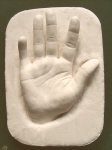
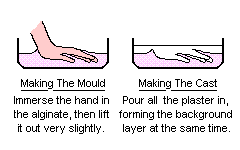
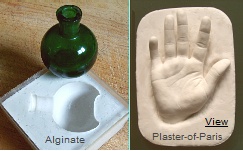
This involves making a flexible mould which is peeled away from the subject once set; the mould is formed in alginate gel which sets in 2 - 3 minutes and will even hold such detail as the pores of the skin. This is the negative which is then coated or filled on the inside with plaster-of-Paris; when the mould is removed the end-result is an exact plaster replica. The method is popular with parents who want to make a cast of their baby's foot or hand. The foot can either be immersed in the alginate, or the alginate can be spread on (using a thick mix) and is peeled off once set. The mould can then be filled with plaster-of-Paris. A hard plaster such as Herculite No.2 is normally used for life-casting, but if the piece is to be left 'as-cast' a pure-white plaster such as Crystacal R can be used. The cast of the 'Hand Emerging' shown below was made in a tuppperware box and was completed in just 30 minutes.
Working with Alginate and Plaster-of-Paris - Casting a Hand
On larger body-areas the alginate will need a supportive backing: if the alginate is applied directly to the tummy and chest and then bandaged in-situ as for the Body-Mould process above, the result is a mould which is sufficiently flexible that it can be separated from the body without distortion; plaster and layers of fabric are then applied on the inside to create the plaster replica, which is a shell rather than a solid mass. This is the method used by mums-to-be who want a naked-skin replica of themselves at the later stages of pregnancy, and is definitely a two or even three-person project, requiring 20 - 30 minutes of close co-operation to make the mould. The casting is often painted - metallic spray is very impressive. Life-cast & mum-to-be kit. Using the same technique, whole body or whole head casts, etc., can be made by casting front and back separately then joining them. Permanent moulds 'from life' using silicone or latex are normally produced from a plaster-of-Paris cast of the face, etc., that has been made using an alginate mould.
Painting & Decorating
Casting plasters will receive most types of paint, but large pieces may take several days to dry sufficiently to avoid the possibility of lifting or peeling of paintwork. A coat of PVA sealer
will improve adhesion and make application easier and more economical for most paints and sprays, particularly on the softer plaster types. The sealer should be applied quickly and lightly to avoid brush-marks being left. In general, plaster objects will deteriorate if left outside or if exposed to moisture - sealing and painting only delays the process - however Cassini's casting plaster does not need any sealing or protection out-of-doors and can be left 'as-cast', or sculpted, etc.
How Much Plaster? As an illustration, it takes about 1.5kg of ordinary Fine Casting plaster to make a block the size of a brick but it would take 2.5kg of Crystacal R plaster - because it is denser. First work out the volume of the finished piece. If this is difficult to measure directly as with a latex mould for instance, use a calibrated jug to see what volume of liquid would fill the mould - or what it would displace - in litres. Multiply this figure by the relative density in the bottom table to find the weight of plaster powder needed in kilograms - then add a little for wastage, etc. So, for a mould that holds 0.4 litres, if using Crystacal R plaster - which has a relative density of 1.67 - you will need around 0.7kg for each casting (0.4 x 1.67 = 0.66kg).
Mixing Plaster-of Paris. Unless you are already experienced and have an eye for the right amounts, always weigh the plaster and use a calibrated jug, etc., for measuring the water, using the water to powder ratios shown in brackets in the left hand column of the table below, e.g. Fine Casting Plaster (70:100) requires 0.7 litres (i.e. 700g) of water for every kilogram of plaster powder used. A small test piece to check the setting time in the particular conditions is always a good idea. Old plaster or plaster that has been stored in damp conditions sets more quickly, as does unset plaster brought into contact with freshly-set plaster. Setting times can be retarded by 10 - 15 minutes simply by adding culinary lemon juice at the rate 1 - 2 teaspoonfuls for each litre of water used. If you haven’t used plaster-of-Paris before you will probably be surprised how runny the fresh mix appears to be.
1.
Weigh out the required amount of plaster into a clean dry vessel; break up any clumps in the powder at this stage.
2.
Measure out the correct amount of water; use tap water only. Use a clean container that will hold around 3x the volume of the loose plaster powder, to ensure plenty of space for mixing the paste.
3.
Gently sprinkle the plaster into the water and allow the material to sink; allow a few minutes for the powder to properly soak.
4.
Mix slowly and firmly using strokes of the stirring tool that limit any air entrainment, i.e. avoid any beating or dropping action; if using an electric drill with a stirring attachment, use a low speed setting.
5.
The fluidity will vary with plaster type, but the mix should have an even consistency, with no bubbles or swellings under the surface, and no free water on top or at the sides of the mix; make certain that there has been no clumping in the corner of the bucket, etc. Tapping will help to bring any air bubbles to the surface.
6.
Allow the mixture to stand for a minute or so before using, and pour gently if making a solid piece to avoid splashing and air entrainment. Again, if feasible, firm tapping of the mould/box will release air bubbles.
7.
The mix can be become quite warm as setting progresses, depending on the normal set time for the particular plaster (see table above), the amount used and ambient temperature, etc. It is usually safe to remove the cast at about 2x set time, when the initial warmth has subsided.
8.
Clean any non-disposable utensils and containers thoroughly in water immediately after use, but never down a drain or sink, etc. Alternatively, if using a flexible plastic bucket, etc, allow the excess plaster to completely set, and crack it off for disposal.
9.
Never attempt to dry any plasters in a microwave or pour molten material into moulds until the plaster is known to be completely dry, as the plaster may explode! Plaster can become very warm during setting - never attempt to embed or mould whole hands, feet or fingers, etc.
Poor quality moulds are usually the result of incorrect curing and premature separation from the prototype/master. Poor quality plaster casts are usually the result of using moulds which are still wet, the plaster mix is too rich, or premature demoulding - allow at least double the stated set-time for intricate work.
Technical information and water-to-powder ratios. Density is a good indicator of impression capability and surface absorption, but the values are approximate and are dependent on the correct water:powder ratio and consistent mixing, etc. Strength characteristics are typical 7-day values.
Plaster-of-Paris Type (Water:powder ratio, by weight).
‡Yield is the approximate volume of finished plaster-of-Paris work measured in litres for each kilogram of dry plaster powder used in the mix.
There is usually some latitude in the choice of plaster - both surface density and absorption can be adjusted with a small change to water content.
†Cassini's has very high flexural strength (resistance to breakage and impact damage). *Suitable for use outdoors, water- and weather-resistant.
For the US Gypsum products Hydrostone, Ultracal 30 and Hydrocal, the UK equivalents are Crystacast, Crystacal R and Herculite No.2 respectively.
Delivery is usually the next working day for most of the UK, but please allow an extra day for 'Highland and Island' addresses and larger orders. Sepal-Maragon, 1 Woodhall Farm, Hatfield, Herts, AL9 5NU. 01707 276156 enquiries@maragon.co.uk. VAT Reg. 911 1205 86.


 A typical plaster for more portable objects is
  3.
3.